

Lean Six Sigma certification helps individuals and organizations build structured problem-solving capability. White Belt creates awareness, Yellow Belt supports improvement teams, Green Belt leads defined projects, and Black Belt handles complex, cross-functional improvement work. The right certification depends on your role, business problem, project responsibility, and the level of impact expected from you.
In this article, you will learn
- What Lean Six Sigma certification means
- The different Lean Six Sigma belt levels
- Which belt level is right for which role
- How certification benefits individuals and organizations
- How to choose the right training path for your team
Why Lean Six Sigma Certification Matters
Most organizations do not fail because people are unwilling to improve. They fail because improvement is unstructured.
Teams discuss problems, attend meetings, assign corrective actions, and close issues. But after a few weeks, the same problems return.
Lean Six Sigma certification gives people a structured way to solve problems using data, process thinking, and disciplined improvement methods. For individuals, it builds career capability. For organizations, it builds internal problem-solving strength.
Certification alone is not the goal. The real goal is to create people who can reduce waste, improve quality, reduce rework, shorten lead time, improve productivity, and sustain business results.
What Is Lean Six Sigma Certification?
Lean Six Sigma certification is a training and capability-building path that helps professionals learn how to improve processes using Lean and Six Sigma methods.
Lean focuses on removing waste and improving flow. Six Sigma focuses on reducing variation, defects, and process instability.
Together, Lean Six Sigma helps teams solve business problems such as high rework, customer complaints, long lead times, excess WIP, poor productivity, process variation, Cost of Poor Quality, delivery delays, and recurring defects.
Certification levels are usually called “belts.” Each belt represents a different level of knowledge, responsibility, and project involvement.
Lean Six Sigma Belt Levels Explained
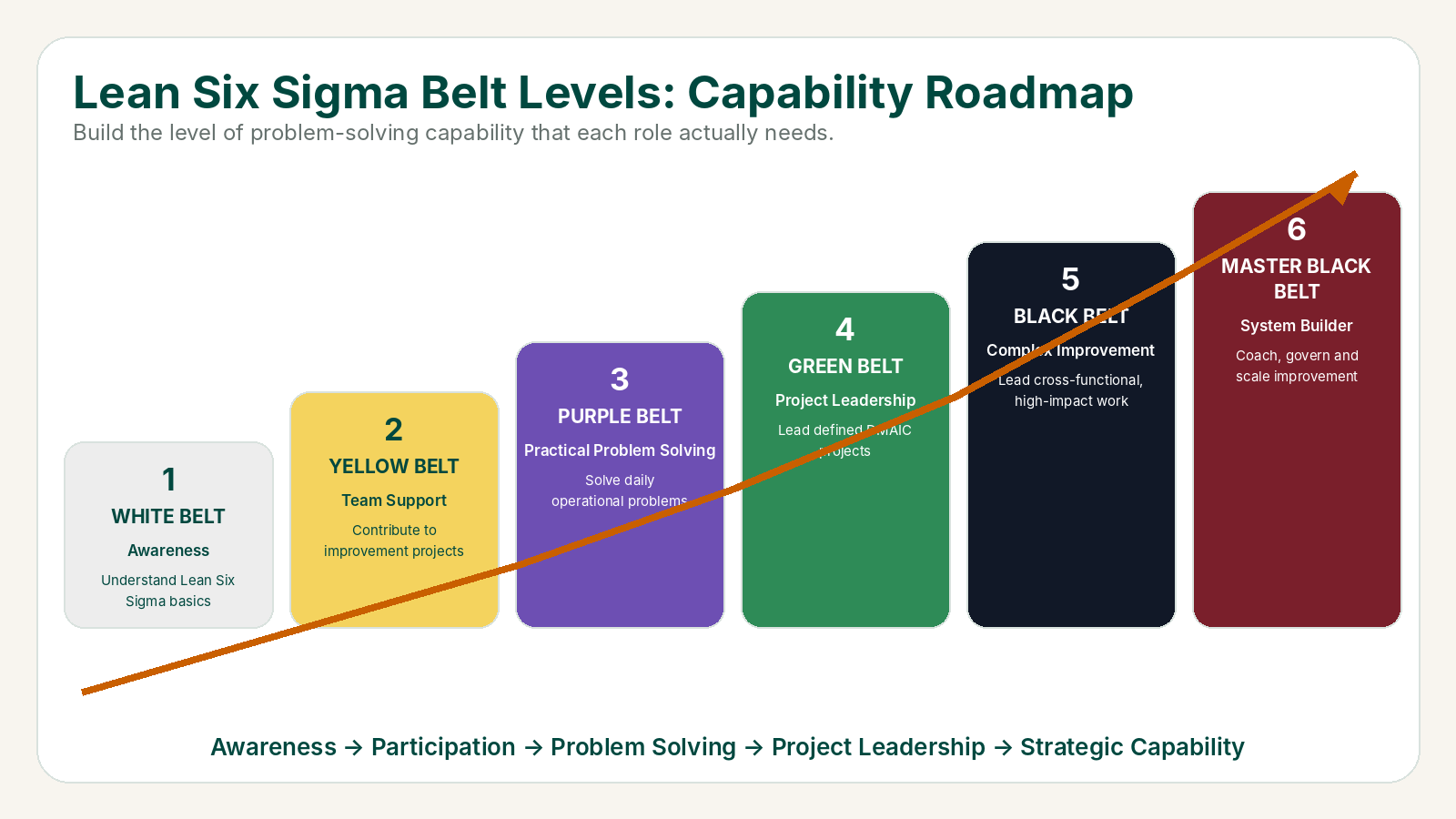
1. White Belt: Awareness Level
White Belt introduces the basic language of improvement. Participants learn what waste means, why defects happen, how processes affect customer value, and why structured problem solving matters.
White Belts usually do not lead projects, but they can participate in improvement activity and support a culture of continuous improvement.
2. Yellow Belt: Team Member Level
Yellow Belt helps people become active contributors to improvement projects. They learn basic tools such as process mapping, 5 Why, Fishbone Diagram, Pareto Analysis, basic data collection, and PDCA thinking.
Yellow Belts often support Green Belt or Black Belt projects by providing process knowledge and helping with data and root-cause analysis.
3. Purple Belt: Practical Problem-Solving Bridge
Purple Belt is not used by every organization globally, but it can be a practical internal capability level. It bridges the gap between Yellow Belt awareness and full Green Belt project leadership.
It is useful for employees who need to solve daily operational problems, support Kaizen events, use simple data, and improve their own work areas.
4. Green Belt: Project Leader Level
Green Belt is where Lean Six Sigma becomes project-driven. Green Belts should be able to lead defined projects using DMAIC: Define, Measure, Analyze, Improve, and Control.
They work on problems with clear business impact, such as reducing rejection, improving first-pass yield, reducing downtime, improving delivery, reducing WIP, or lowering COPQ.
5. Black Belt: Complex Problem-Solving Level
Black Belts handle complex problems that are often cross-functional. They use deeper statistical thinking, stakeholder management, project governance and change leadership.
A Black Belt may mentor Green Belts, guide improvement teams, lead high-value projects, and support leadership in building a larger improvement system.
6. Master Black Belt: System Builder Level
A Master Black Belt works at system level. They mentor Black Belts and Green Belts, design training structures, align projects with strategy, define governance, and help build the organization’s improvement architecture.
Not every organization needs a Master Black Belt immediately. But every organization needs someone thinking about how improvement capability will scale and sustain.
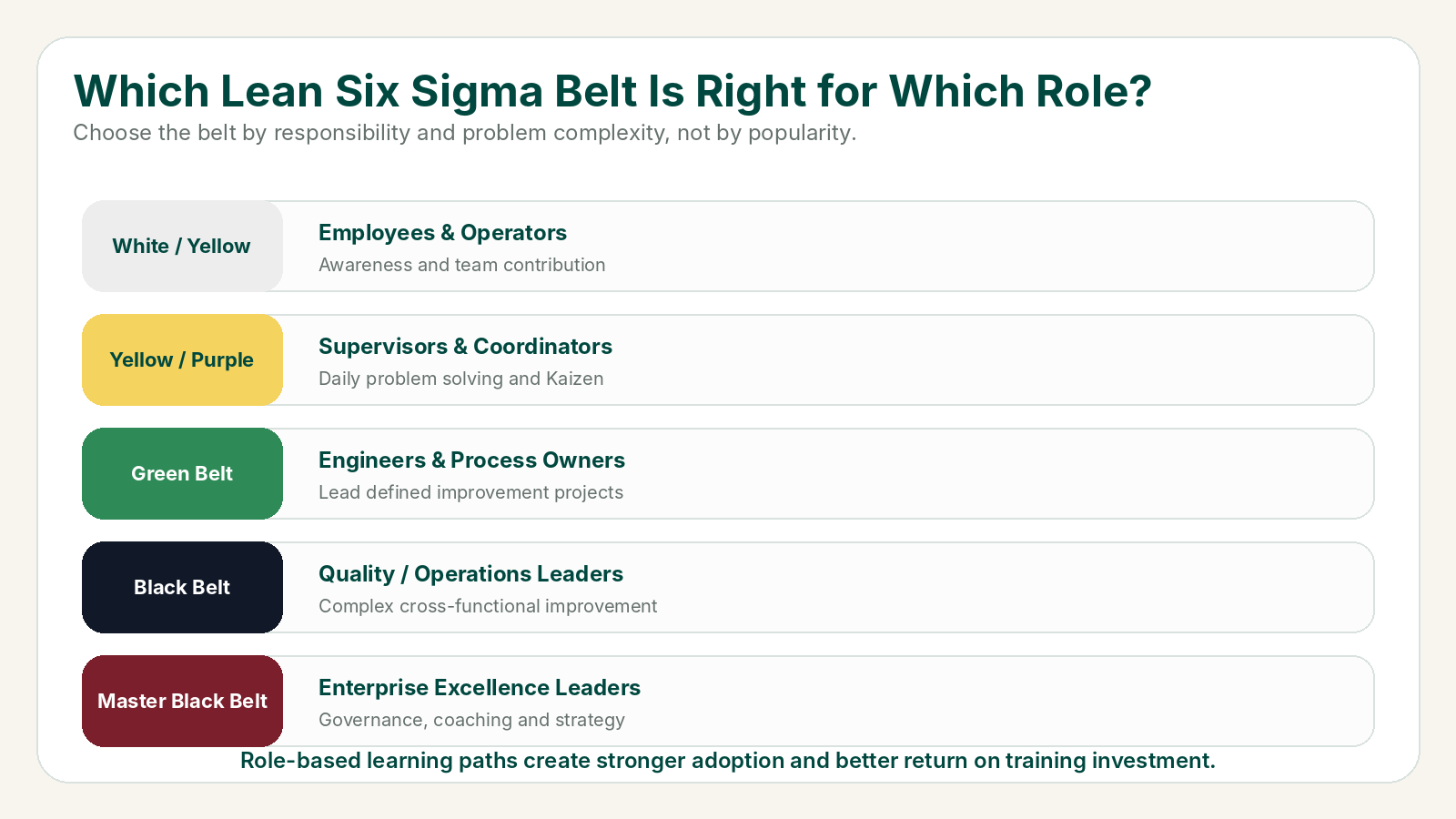
Which Lean Six Sigma Belt Is Right for You?
The right belt depends on your role and responsibility. The better question is not “Which belt is popular?” It is: What level of problem-solving capability does each role need?
Benefits of Lean Six Sigma Certification
For individuals, Lean Six Sigma certification improves structured thinking, data-based decision-making, problem-solving confidence, and career growth.
For organizations, the benefits are bigger. A good training roadmap can help reduce rework, improve quality, lower COPQ, increase productivity, reduce lead time, improve customer satisfaction, and build internal capability.
It also reduces dependency on a few senior people. When more employees understand how to solve problems properly, the organization becomes stronger.
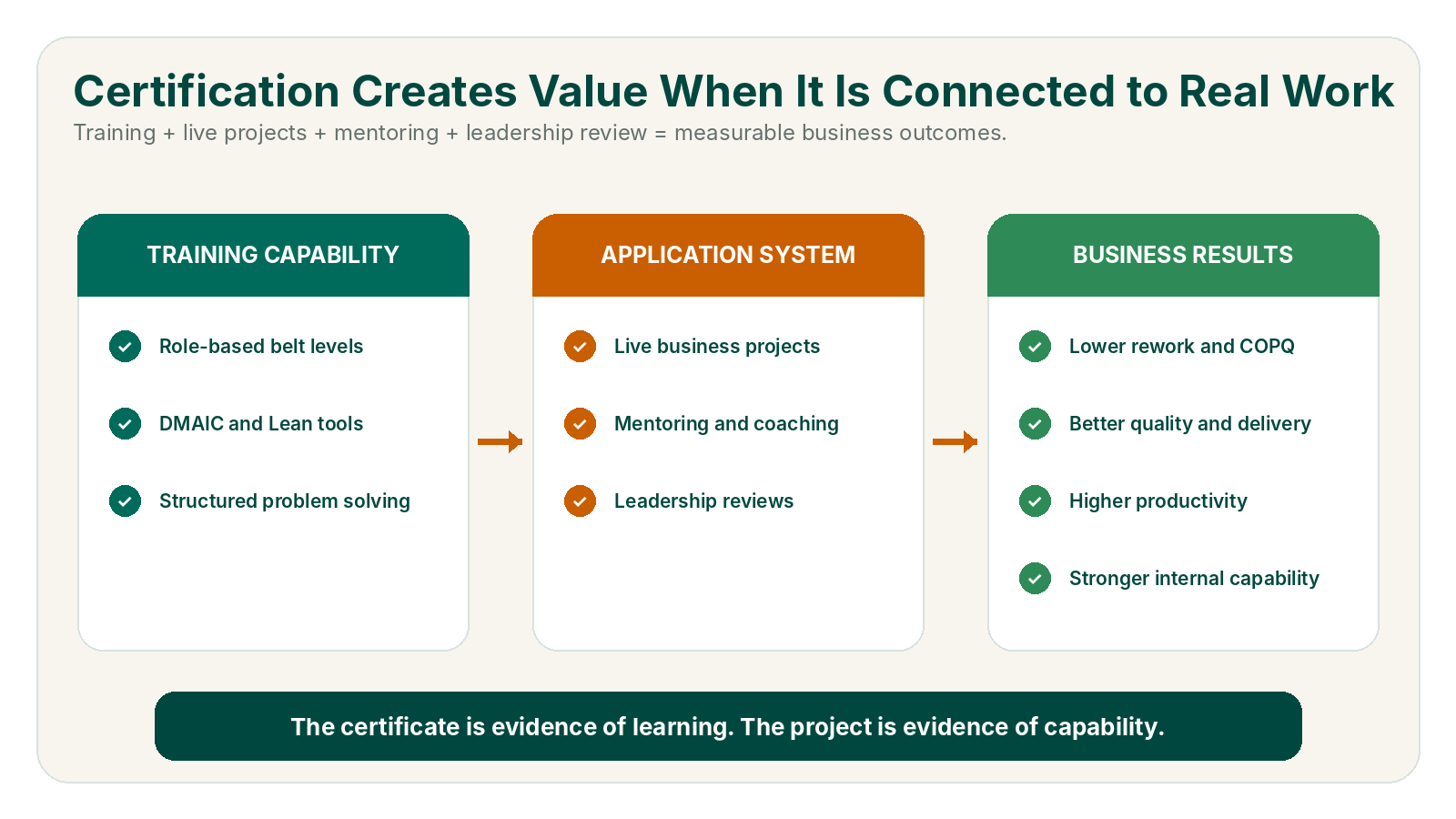
RAAS connects Corporate Lean Six Sigma Trainings with live Lean Six Sigma Projects, mentoring and leadership reviews so training is applied, not merely completed.
RAAS Point of View
At RAAS Consultancy, Lean Six Sigma training is not treated as a certificate activity. It is treated as capability building.
The purpose is not to create certificate holders. The purpose is to create problem solvers who can improve the business.
A strong training roadmap should connect belt levels with live business problems, leadership reviews, project mentoring, and measurable outcomes. That is how training turns into performance improvement.
Organizations can combine training with Value Stream Mapping, Root Cause Analysis, Lean Six Sigma Projects, and Green Belt Training and Black Belt Mentoring to create a stronger internal improvement system.
Practical Takeaway: Choose the Training Path Around Business Need
Before choosing Lean Six Sigma certification, ask five questions:
If these questions are clear, certification becomes an investment. If they are not clear, certification becomes only an event.

Final Thought
Lean Six Sigma certification can be powerful when it is used correctly.
White Belt builds awareness. Yellow Belt builds participation. Purple Belt builds practical problem-solving. Green Belt builds project leadership. Black Belt builds advanced improvement capability. Master Black Belt builds the system.
The right belt level is not about title. It is about the type of problem you are expected to solve.

Asim Inamdar
Asim brings more than two decades of Lean Six Sigma and operational excellence experience across manufacturing and service environments. RAAS Consultancy focuses on measurable business results and building internal problem-solving capability.
Frequently Asked Questions
1. What is Lean Six Sigma certification?
Lean Six Sigma certification is a structured training path that helps professionals learn how to reduce waste, solve problems, improve processes, and sustain measurable business results.
2. Which Lean Six Sigma belt should I start with?
If you are new to Lean Six Sigma, start with White Belt or Yellow Belt. If you are expected to lead improvement projects, Green Belt is usually the right starting point.
3. What is the difference between Green Belt and Black Belt?
Green Belts lead defined improvement projects within a function or process. Black Belts handle more complex, cross-functional projects and often mentor Green Belts.
4. Is Lean Six Sigma certification useful for manufacturing companies?
Yes. Lean Six Sigma is highly useful in manufacturing because it helps reduce defects, rework, downtime, WIP, lead time, and Cost of Poor Quality.
5. Is certification enough to deliver business results?
No. Certification should be connected to live projects, mentoring, leadership reviews, and measurable outcomes. Training without application has limited value.
6. Can companies train different teams at different belt levels?
Yes. In fact, that is usually the best approach. Different roles need different levels of Lean Six Sigma capability.