

Engineering rework costs more than the extra hours spent correcting drawings or revising designs. It also delays procurement, disrupts manufacturing, increases review cycles, creates customer dissatisfaction, reduces engineering capacity, and affects profitability. Lean Six Sigma helps reduce engineering rework by identifying process waste, measuring design defects, finding root causes, standardizing reviews, and improving first-time-right design quality.
In this article, you will learn
- Why engineering rework is often underestimated
- Where the hidden cost of design rework appears
- How rework affects procurement, manufacturing, and delivery
- Which Lean Six Sigma tools help reduce design rework
- How to start with an Engineering Rework Diagnostic
Engineering Rework Is Not Just a Design Problem
Most organizations understand the cost of scrap in manufacturing. A defective part is visible. A rejected batch is visible. A rework station is visible. A delayed dispatch is visible.
But engineering rework is different. It often hides inside inboxes, CAD revisions, customer comments, internal review loops, clarification calls, approval delays, and late-stage design changes.
Because there is no physical scrap bin, many organizations underestimate the true cost.
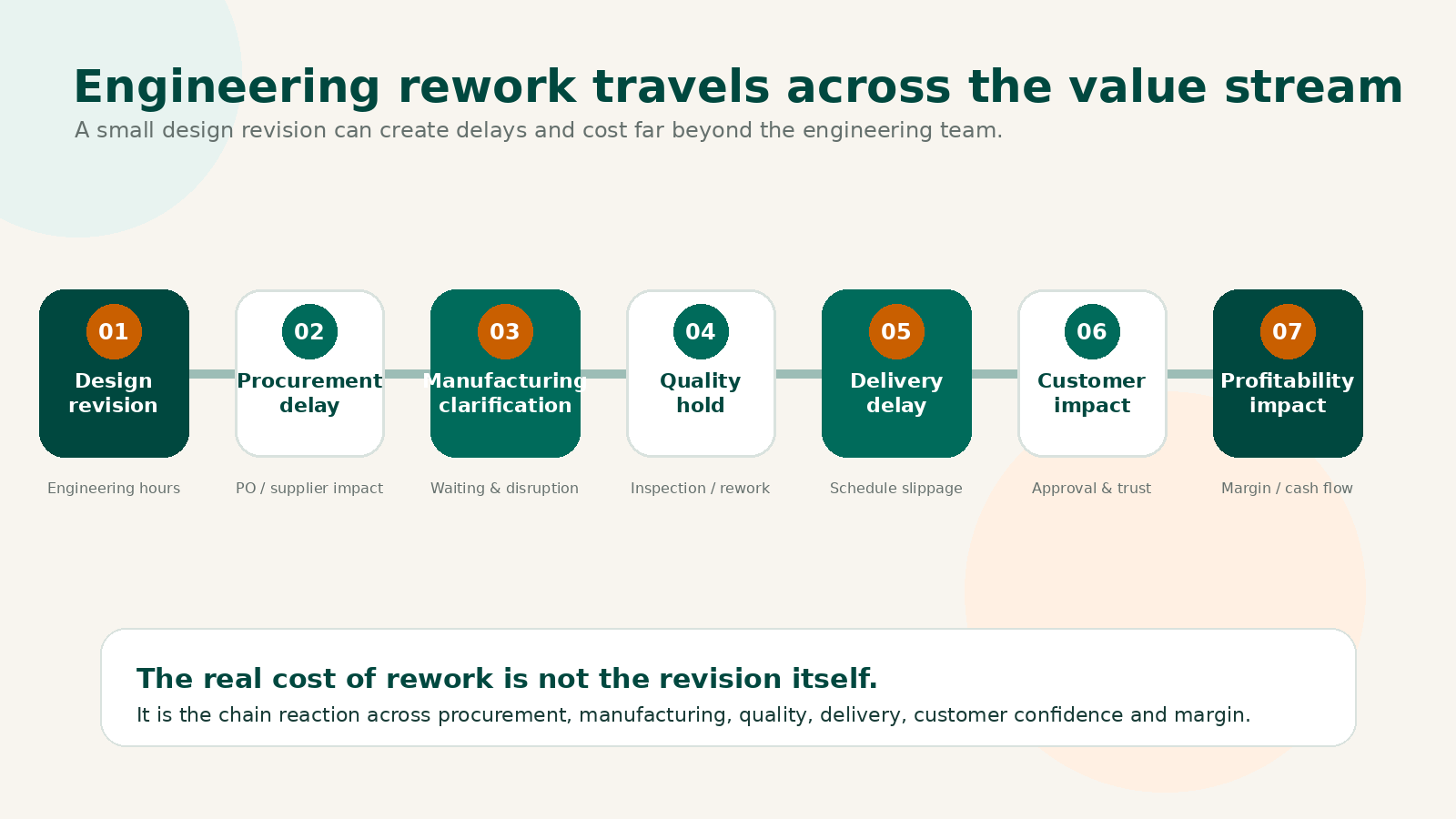
A drawing revision may look like a small correction. But that small correction may trigger procurement changes, manufacturing delays, quality concerns, supplier confusion, customer re-approval, and project rescheduling.
Engineering rework is not a small design cost. It is a value-stream loss that can move through the entire business.
The Visible Cost: Extra Engineering Hours
The most obvious cost of engineering rework is time.
Engineers spend additional hours correcting drawings, updating models, changing BOMs, revising calculations, attending review meetings, and responding to clarification requests.
This creates direct productivity loss. Instead of working on new designs, innovation, customer requirements, or value-added engineering, skilled engineers spend time correcting work that should have been right the first time.
This has a simple business impact: engineering capacity reduces without any visible increase in headcount cost. The team looks fully occupied, but a significant part of its capacity is being consumed by rework.
The Manufacturing Impact: Confusion, Waiting, and Rework
Manufacturing teams depend on clear, complete, and correct design inputs.
When drawings are unclear, incomplete, or revised late, manufacturing faces avoidable friction. Operators wait for clarification. Supervisors raise questions. Quality teams hold production. Manufacturing engineers suggest changes. Parts may need rework. Assemblies may get delayed.
In some cases, the design may be technically correct but difficult to manufacture. This creates another form of waste. The part can be made, but only with extra effort, special handling, longer setup time, or repeated inspection.
This is why Design for Manufacturability is important. A design should not only work on paper. It should work smoothly in production.
The Customer Impact: Lost Confidence
Customers rarely see the internal reasons behind delays. They only see repeated revisions, delayed approvals, unclear responses, missed timelines, or final output that does not match expectations.
Engineering rework can directly affect customer confidence. If the customer has to review the same design multiple times, trust reduces. If changes happen late, the customer begins to question capability. If delivery slips because of engineering errors, the relationship becomes strained.
Customers may tolerate one delay. They may not tolerate repeated uncertainty.
Why Engineering Rework Happens
Engineering rework is rarely caused by one person. It is usually a process issue.
Incomplete inputs
Customer requirements, technical data, or commercial handovers are incomplete at the start.
Weak standards
Design practices, templates, release rules, and review criteria vary by person or project.
Late cross-functional feedback
Manufacturing, quality, procurement, or supplier input comes after design decisions are already locked.
Poor change control
Version control, revision reasons, lessons learned, and ownership are not managed consistently.
Common causes include incomplete customer requirements, poor handover from sales or project teams, unclear design standards, lack of review checklists, late manufacturing feedback, weak version control, missing lessons learned, BOM errors, inconsistent design practices, approval delays, and overdependence on individual experience.
Adding more review meetings may reduce some errors, but it often increases cycle time. The better approach is to improve the process.
How Lean Six Sigma Reduces Engineering Rework
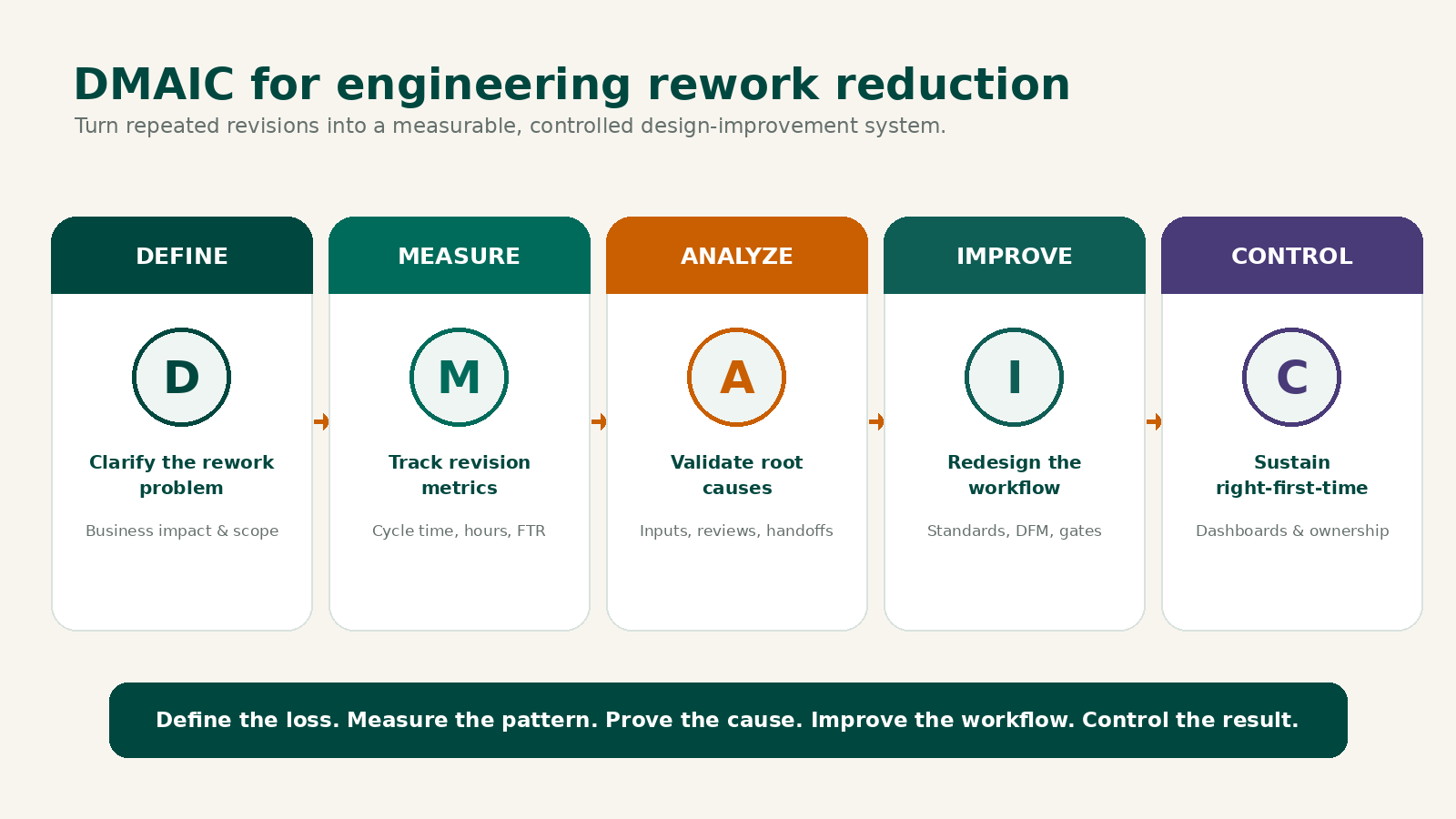
Lean Six Sigma Projects help engineering teams reduce rework in a structured way. The method studies the workflow, measures the gaps, identifies root causes, and improves the system without relying on blame.
1. Define the Problem Clearly
A weak problem statement is: “Engineering rework is high.” A stronger statement is: “Design revisions for industrial assembly projects increased from two to five average iterations per project, delaying drawing release by 12 days and affecting procurement and manufacturing schedules.”
This makes the problem measurable and connects design loss to business impact.
2. Measure the Right Metrics
Engineering teams should track the process measures that reveal where capacity is being lost:
- Number of revisions per drawing
- First-pass approval rate
- Design cycle time
- Drawing release lead time
- BOM correction frequency
- Customer comment cycles
- Manufacturing clarification requests
- Rework hours per project
- On-time design release
- Design-related production issues
3. Analyze Root Causes
Tools like Pareto Analysis, Fishbone Diagram, 5 Why Analysis, Process Mapping, FMEA, and Value Stream Mapping help identify where rework starts.
For example, analysis may show that 60% of revisions come from unclear customer inputs, late manufacturing review, or missing design standards. That insight changes the solution.
Instead of telling engineers to “be more careful,” the organization improves the input checklist, review gate, and standard library.
4. Improve the Design Workflow
Once the root cause is validated, the workflow can be redesigned around first-time-right quality.
- Customer requirement checklist
- Design review checklist
- Standard drawing templates
- Modular design libraries
- DFM review before release
- Revision reason coding
- Knowledge repository
- Clear release criteria
- Better change control
- Cross-functional review gates
The goal is simple: make first-time-right design easier.
5. Control the Gains
Engineering dashboards, review discipline, standard work, audits, lessons-learned reviews, and ownership routines help prevent teams from returning to old habits.
The real question is not, “Did we reduce rework once?” It is, “What prevents this rework from returning in the next project?”
RAAS Point of View
At RAAS Consultancy, engineering rework is viewed as a value stream issue, not just an engineering department issue.
When design rework reduces, the entire business improves. Engineering capacity improves. Procurement receives clearer inputs. Manufacturing faces fewer clarifications. Quality issues reduce. Project timelines become more predictable. Customers gain confidence.
RAAS helps organizations improve such processes using Lean Six Sigma, Value Stream Mapping, Root Cause Analysis, 7 QC Tools, Kaizen, and Corporate Trainings.
The objective is not only to reduce revisions. The objective is to build an engineering process that delivers better designs, faster, with fewer surprises.
Practical Takeaway: Calculate the Real Cost of Rework
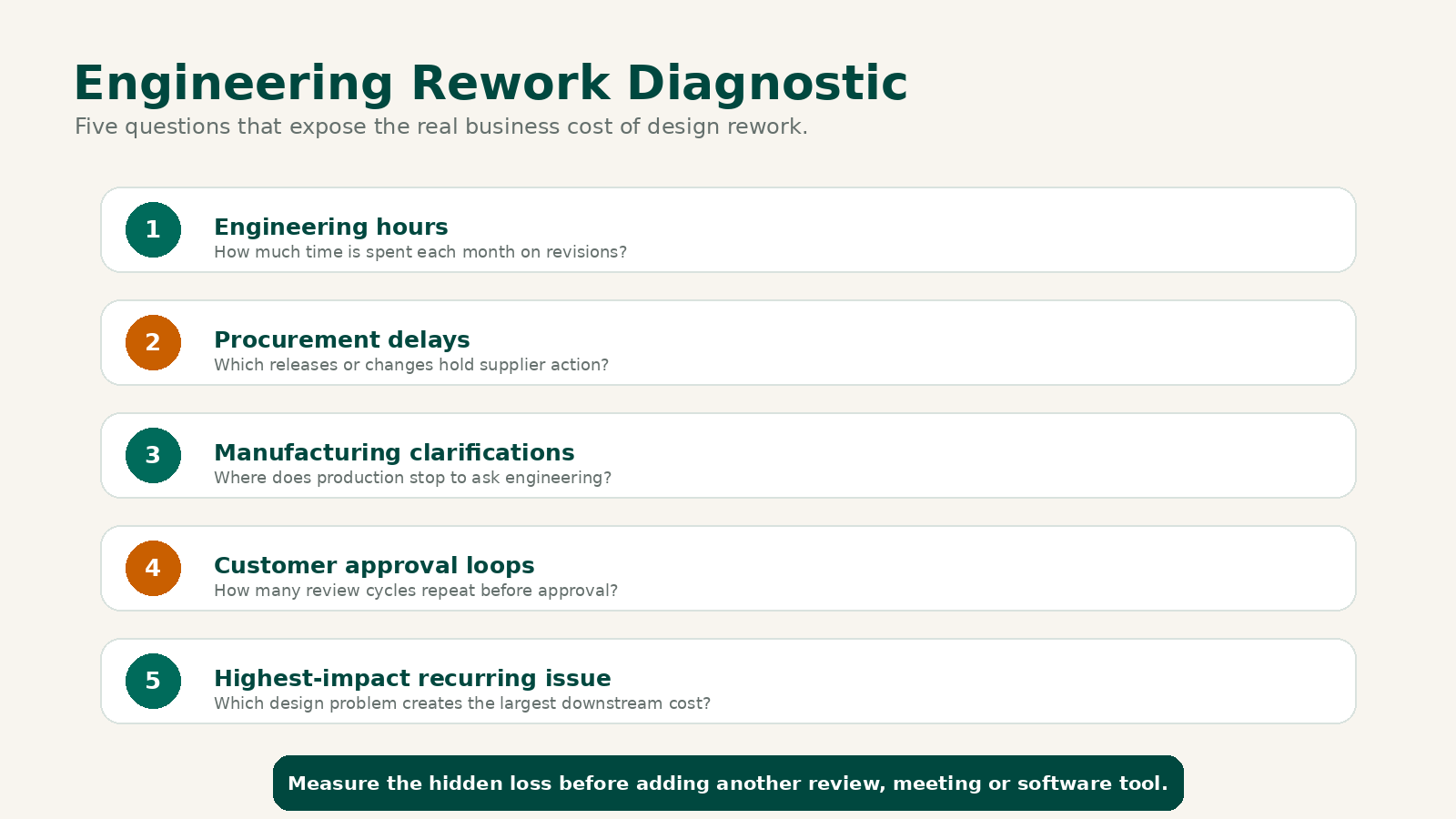
Before assuming engineering rework is a normal part of design, calculate its true cost.
How many hours are spent every month on design revisions?
How many procurement delays are caused by late or revised drawings?
How many manufacturing clarifications come from design issues?
How many customer approval cycles are repeated?
Which recurring design issue creates the highest business impact?
The answers often reveal that engineering rework is not a small internal cost. It is a hidden business loss.
Final Thought
Engineering rework costs more than extra design hours. It affects delivery, procurement, manufacturing, quality, customer trust, engineering morale, and profitability. The solution is not simply more meetings, more checking, or more software. The solution is a better engineering process. Lean Six Sigma gives teams the structure to reduce rework, improve first-time-right quality, and accelerate design cycle time.


Asim Inamdar
Founder & Lean Six Sigma Black Belt, RAAS Consultancy. RAAS focuses on practical operational excellence, measurable results, and building internal problem-solving capability.
Frequently Asked Questions
1. What is engineering rework?
Engineering rework is the time and effort spent correcting, revising, clarifying, or redesigning engineering outputs after they should have been completed or released.
2. Why is engineering rework costly?
Engineering rework is costly because it consumes skilled engineering time, delays procurement, disrupts manufacturing, increases review cycles, affects delivery, and reduces customer confidence.
3. What causes design rework?
Common causes include incomplete requirements, poor handovers, unclear standards, weak review systems, late manufacturing feedback, BOM errors, and poor version control.
4. How can Lean Six Sigma reduce engineering rework?
Lean Six Sigma reduces engineering rework by defining the problem, measuring rework drivers, analyzing root causes, improving design workflows, and controlling the process.
5. What metrics should engineering teams track?
Useful metrics include revision count, first-pass approval rate, design cycle time, rework hours, drawing release lead time, customer comment cycles, and manufacturing clarification requests.
6. Where should a company start?
Start by mapping the complete engineering workflow and identifying where the highest rework, waiting, or clarification load occurs.