

Voice of Customer, or VOC, helps engineering service teams understand what customers truly need before design work begins. It converts customer expectations, technical requirements, performance needs, usage conditions, constraints, and quality expectations into clear engineering inputs. When VOC is captured properly, engineering teams reduce rework, improve first-time-right design, shorten approval cycles, and deliver solutions that customers actually value.
In this article, you will learn
- Why engineering rework often starts with weak customer understanding
- What Voice of Customer means in engineering services
- How VOC connects customer needs with technical requirements
- How Lean Six Sigma improves requirement capture and design quality
- How engineering teams can start using VOC more effectively
Engineering Quality Starts Before the First Drawing
Many engineering teams believe design quality begins when the engineer starts working on a drawing, model, calculation, or BOM. In reality, design quality starts much earlier. It starts when the customer explains the problem.
If the customer need is unclear, incomplete, misunderstood, or poorly translated into technical requirements, the design team may work hard and still deliver the wrong output.
That is why many engineering projects go through repeated revisions. The drawing may be technically correct, but it may not fully reflect customer expectations. The model may follow internal standards, but may miss site constraints. The BOM may be accurate, but may not match the customer’s operational preference. The design may pass review, but fail to satisfy the user.
Design quality starts with requirement quality. Better customer understanding reduces downstream engineering rework.
This is where Voice of Customer becomes critical.
What Voice of Customer Means in Engineering Services
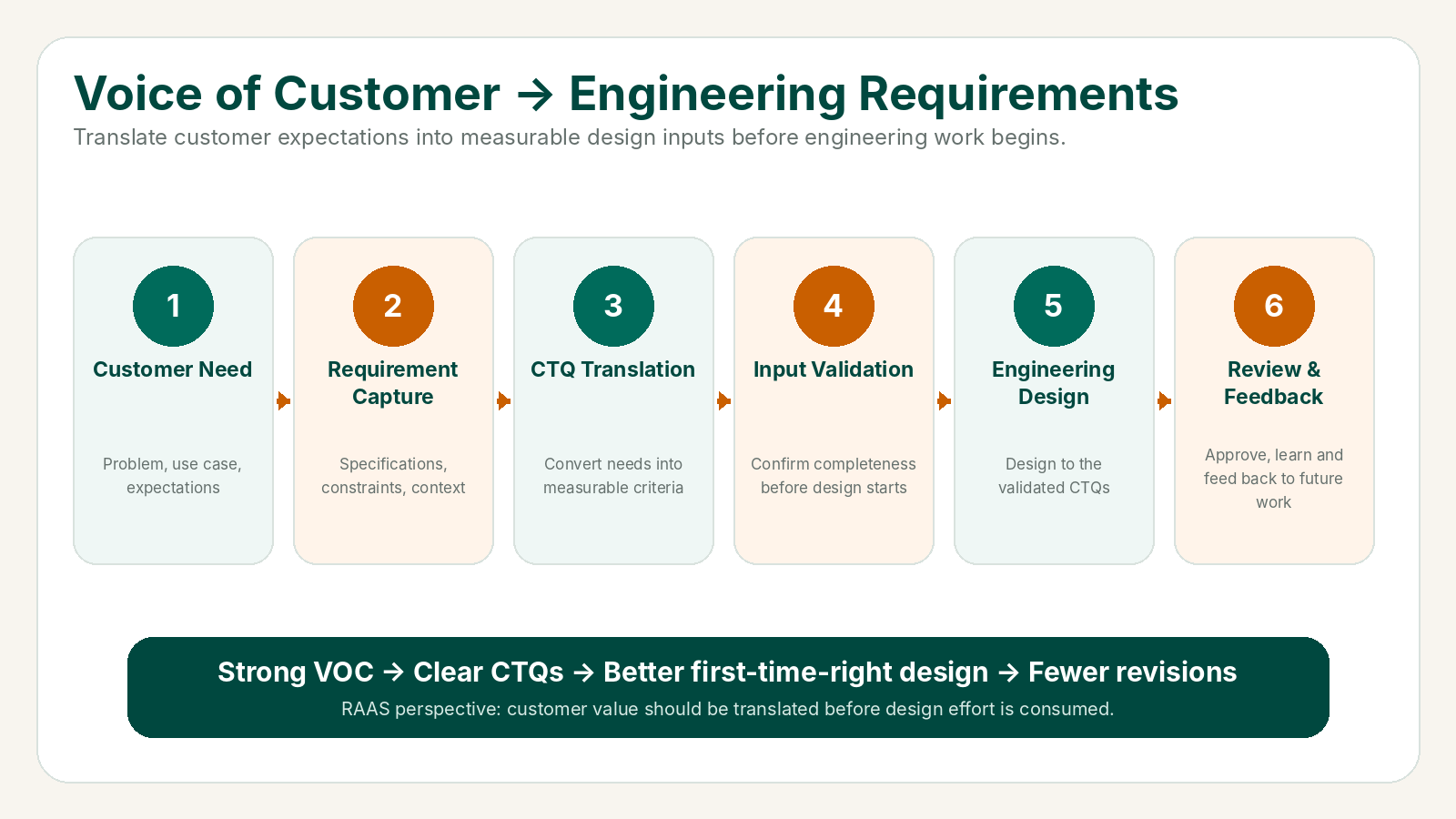
Voice of Customer is the structured process of capturing, understanding, and translating customer needs into measurable requirements.
In engineering services, VOC should go beyond “What does the customer want?” It should answer what problem the customer is trying to solve, how the design will be used, which operating conditions and site constraints matter, what quality and safety expectations exist, what has failed in the past, and what success looks like.
The goal is not only to collect information. The goal is to convert customer expectations into clear design inputs.
Why Engineering Teams Miss the Real Customer Need
Customer requirements are often captured through emails, calls, meetings, drawings, tender documents, specifications, and informal conversations. The challenge is that these inputs are not always complete.
Customers may assume certain things are obvious. Sales teams may capture commercial requirements but miss technical details. Project teams may focus on timelines but overlook manufacturability. Engineering teams may start design before all critical inputs are validated.
Incomplete specifications
Critical technical inputs or operating requirements are missing at the start.
Unclear performance expectations
The desired outcome is described qualitatively but not converted into measurable criteria.
Missing operating conditions
Site, environment, maintenance, load or usage conditions are assumed instead of validated.
Weak handover
Sales, project, engineering, manufacturing and quality interpret the same requirement differently.
Other common VOC gaps include poorly defined acceptance criteria, late customer clarification, assumptions made by internal teams, no structured requirement checklist, and no clear link between customer need and design parameter.
These gaps become design rework later.
How Lean Six Sigma Strengthens VOC
Lean Six Sigma Projects help engineering teams make VOC more structured, measurable, and actionable. Instead of depending only on informal discussions, teams can capture requirements systematically and translate them into Critical-to-Quality requirements, or CTQs.
Customer says: “The equipment should be easy to maintain.”
Engineering CTQ: Maintenance access time should be under a defined limit, key parts should be reachable without dismantling major assemblies, and maintenance instructions should be included.
Customer says: “We need faster installation.”
Engineering CTQ: Design should reduce installation steps, simplify alignment, minimize special tools, and include clear assembly references.
Customer says: “The design should be robust.”
Engineering CTQ: The design must meet load, safety, vibration, environment, and lifecycle requirements with defined acceptance criteria.
The engineering value is created when a broad customer expectation becomes a measurable design requirement.
VOC in the DMAIC Framework
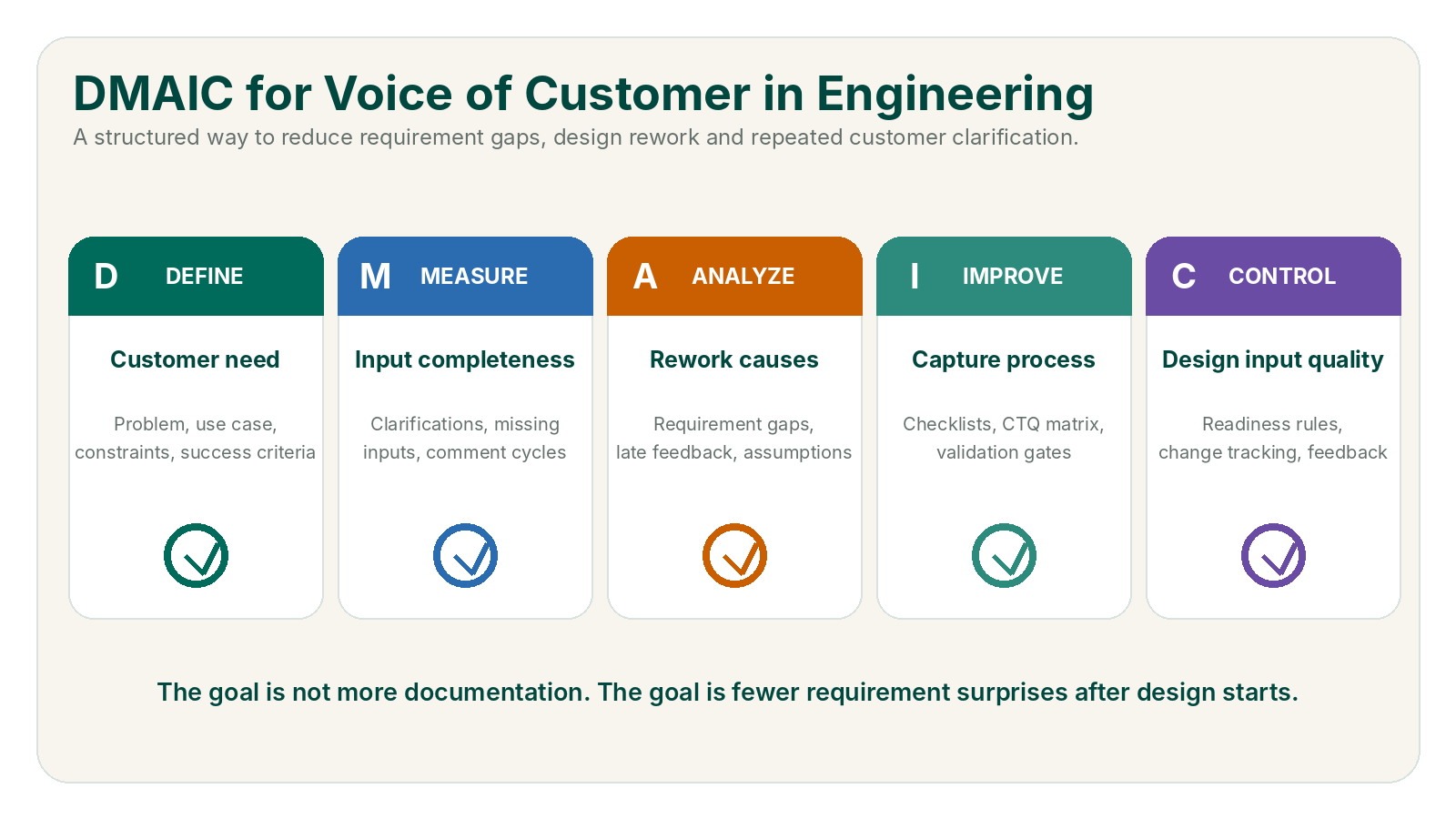
Lean Six Sigma uses DMAIC: Define, Measure, Analyze, Improve, and Control. VOC plays a major role, especially in the Define phase.
1. Define the Customer Need Clearly
Before design begins, the team should define the customer problem, application, expected outcome, constraints, and success criteria. A weak requirement is “Design a support structure.” A better requirement defines the load, operating environment, installation condition, maintenance access need, and customer approval requirement.
2. Measure Requirement Completeness
Engineering teams should track how complete the input package is before starting design. Useful metrics include requirement completeness score, clarification cycles, missing input count, customer comment cycles, first-pass approval rate, design revision count, change requests after release, and manufacturing clarification requests.
3. Analyze Rework Caused by Requirement Gaps
If design rework is high, teams should study how much is caused by poor VOC. Root Cause Analysis, Pareto Analysis, Fishbone Diagram, 5 Why Analysis and Value Stream Mapping help identify whether revisions are linked to missing inputs, unclear specifications, late stakeholder feedback, or weak handover.
4. Improve Requirement Capture
- Customer requirement checklist
- Technical clarification template
- Application review before design start
- CTQ matrix
- Design input validation meeting
- Standard handover format from sales to engineering
- Early manufacturing and quality review
- Lessons-learned repository
- Customer approval criteria checklist
5. Control the VOC Process
VOC should not depend only on individual experience. Teams need standard work. Before design starts, there should be clear criteria for input readiness. During design, changes should be tracked. After delivery, customer feedback should be captured and fed into future projects.
This converts VOC from a one-time discussion into a continuous improvement system.
Practical Example: Reducing Design Revisions Through VOC
Imagine an engineering services company facing repeated drawing revisions. The team assumes engineers need more review time.
But analysis shows that most revisions are caused by incomplete customer inputs, unclear installation constraints, and late manufacturing feedback.
The improvement is not simply adding another review meeting. The better improvement is a structured VOC checklist, a CTQ matrix, a customer clarification gate, and an early Design for Manufacturability review.
The result is fewer revisions, faster approvals, smoother handover, and better customer confidence.
RAAS Point of View
At RAAS Consultancy, VOC is treated as a core part of engineering and operational excellence.
Engineering teams should not only ask what the customer wants. They should understand what the customer values, what the process requires, and what the business must deliver.
RAAS helps organizations improve engineering and operational processes through Lean Six Sigma, Value Stream Mapping, Root Cause Analysis, 7 QC Tools, Kaizen, and Corporate Trainings.
The goal is simple: reduce avoidable rework, improve first-time-right output, and build systems that help teams deliver customer value consistently.
Practical Takeaway
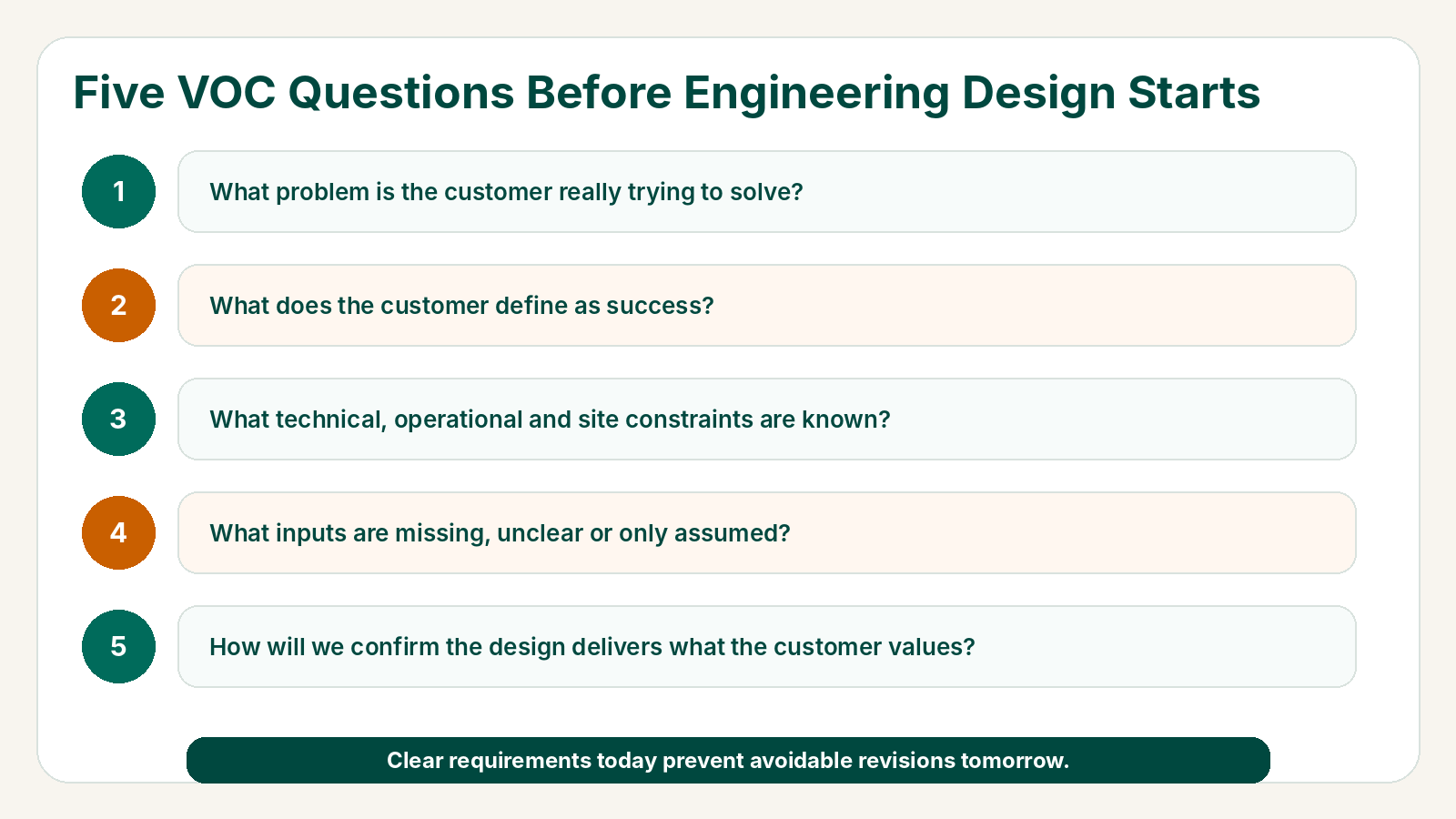
Before starting your next engineering design project, ask five VOC questions:
What problem is the customer really trying to solve?
What does the customer define as success?
What technical, operational, and site constraints are known?
What inputs are missing or assumed?
How will we confirm that the design meets what the customer truly values?
These questions can prevent weeks of rework.
Final Thought
Engineering excellence is not only about technical skill. It is also about understanding customer value clearly and early. When Voice of Customer is weak, design teams work harder but still face rework. When VOC is strong, engineering teams design with clarity, confidence, and purpose.
Better VOC leads to better designs. Better designs lead to fewer revisions. Fewer revisions lead to faster delivery. Faster delivery leads to stronger customer trust.
That is why Voice of Customer should be a core part of every engineering services process.


Asim Inamdar
Founder & Lean Six Sigma Black Belt, RAAS Consultancy. RAAS focuses on practical operational excellence, measurable results, and building internal problem-solving capability.
Frequently Asked Questions
1. What is Voice of Customer in engineering services?
Voice of Customer in engineering services is the structured process of capturing customer needs, expectations, constraints, and success criteria, then translating them into clear engineering requirements.
2. Why is VOC important for engineering design?
VOC is important because unclear customer requirements often lead to design rework, repeated revisions, approval delays, and customer dissatisfaction.
3. How does Lean Six Sigma improve VOC?
Lean Six Sigma improves VOC by converting customer needs into measurable CTQs, using structured requirement capture, analyzing rework causes, and controlling the design input process.
4. What are CTQs in engineering?
CTQs, or Critical-to-Quality requirements, are measurable engineering requirements derived from customer expectations. They help translate customer needs into design parameters.
5. What metrics should engineering teams track for VOC?
Useful metrics include requirement completeness, clarification cycles, first-pass approval rate, revision count, customer comment cycles, and design changes after release.
6. Where should an engineering team start?
Start by mapping the requirement capture process and identifying where customer inputs are incomplete, unclear, delayed, or assumed.